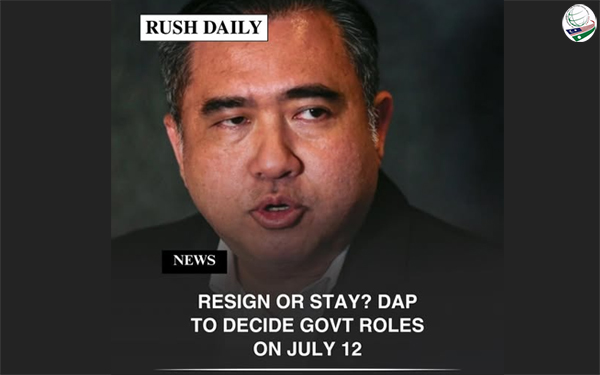
The decision by the Democratic Action Party (DAP) to hold a special congress on July 12 to determine whether its officeholders should resign from all government positions while continuing to support the unity government in Parliament opens a new chapter in the country’s political dynamics.
Its secretary-general, Anthony Loke, described the gathering as an internal “referendum” to allow delegates to determine the party’s role within the administration.
A report by Sin Chew Daily quoted him as saying that even if members vote to withdraw from executive positions, DAP’s 40 Members of Parliament would continue backing the government led by Prime Minister Anwar Ibrahim until the next general election.
On the surface, this move appears to clarify the party’s position within the unity government.
However, from a deeper political perspective, it raises serious questions about DAP’s sincerity and political courage.
A Safe Tactic or Political Responsibility?
In a parliamentary democracy, participation in government is not merely about holding office; it is about sharing collective responsibility.
If a government policy or decision sparks controversy, it is the collective responsibility of all parties represented in the Cabinet.
Yet the proposal to relinquish executive posts while continuing to support the government in Parliament creates the impression that DAP wants to retain the advantages of power without fully bearing the burden of responsibility.
The question is simple: if the party is no longer comfortable being part of the administration, why maintain parliamentary support?
And if it still supports the government, why step down from executive positions?
This halfway measure can be interpreted as a pre-election political strategy, an attempt to distance itself from controversial government issues while ensuring the administration’s survival until the end of the term.
The Burden on the Unity Government
The unity government formed after the 15th General Election was built on compromise and stability.
It requires all component parties to stand firmly together, especially in the face of economic pressures, rising living costs, and sensitive racial and religious sentiments.
However, throughout this administration, various controversies have arisen, often linked to statements or positions taken by DAP leaders.
Although the party denies certain allegations, public perception persists among segments of society that DAP carries a particular political burden for the government.
Now, as speculation about the next general election intensifies, the proposal to “leave the Cabinet but continue supporting” creates the impression that the party is attempting to distance itself from the administration’s weaknesses without risking a total loss of power.
For critics, this is not a bold move; it is a self-preservation strategy ahead of elections.
Internal Referendum or Perception Strategy?
Anthony Loke has framed the special congress as an internal referendum.
But in politics, public perception often matters more than terminology.
If the final decision is to withdraw from government positions, DAP may argue that it respects grassroots voices.
At the same time, by retaining the support of its 40 MPs, the party remains a decisive factor in the government’s survival.
This strategy allows DAP to tell its supporters that it is “no longer bound by Cabinet decisions,” while assuring coalition partners that the government will not collapse.
The question remains: is this genuine political accountability, or merely a tactical maneuver to safeguard party interests?
Political Risk and the Test of Sincerity
In politics, true courage is tested when a party is willing to take risks for its principles.
If there are indeed big differences or discomfort within the administration, the clearest option would be to withdraw support entirely and return to the people for a fresh mandate.
Choosing the middle path, exiting the executive while continuing parliamentary support, gives the impression that DAP seeks to avoid the risk of losing influence while attempting to polish its image before elections.
For some observers, this appears inconsistent.
Harsh critics describe it as an attempt to “wash its hands” after having enjoyed the privileges of power.
As Elections Approach: Perception Will Decide
Whatever the outcome of the special congress, the issue will undoubtedly become campaign material and a subject of political debate.
Opponents will question DAP’s consistency.
Supporters will defend the move as a legitimate democratic strategy.
But for voters observing from outside party lines, the fundamental question remains: is this action driven by principle, or by electoral calculation?
In an increasingly challenging political climate, the public is more discerning than ever.
They are not only watching what is done, but also why it is done and when it is done.
The July 12 decision will not merely determine DAP’s position within the government; it will reflect whether the party is prepared to shoulder political responsibility fully, or whether it prefers the safest path for the sake of power.
Conclusion
Ultimately, the real issue is not whether DAP remains in the Cabinet, but the integrity and consistency of its politics.
If it has shared power all this while, it must also share the administration’s burdens and shortcomings.
It is questionable that, as elections draw near, talk emerges of “withdrawing honorably” while still retaining parliamentary power.
Such a half-measure creates the impression of separating from government liabilities without relinquishing the benefits of power.
Put simply, it appears as an effort to protect the image without daring to face risk.
The people are watching. Politics is not merely about strategy; it is about honesty toward the mandate given.
If there are principles worth defending, they should be upheld decisively and courageously.
Otherwise, the public is entitled to view this as opportunistic maneuvering that surfaces only when the shadow of elections looms near.
In politics, courage is tested in the face of risk, not in the search for the safest path.