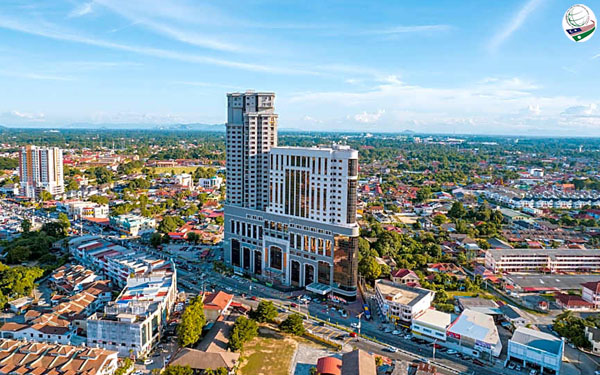
When staying at the Renaissance Hotel, Kota Bharu, Lee Kuan Yew was accompanied by a hotel chef from Ipoh, a Chinese man.
This chef had been working in Kelantan for almost five years.
In a casual conversation, he expressed how happy he was living in Kelantan.
He said he no longer wished to return to Ipoh permanently and was even considering buying a house and bringing his family to live here.
This was a genuine experience, not fabricated or embellished. And it was touching.
People often say PAS is too exclusive, focusing only on Islam, paying little attention to Malaysia’s multiracial society, not inclusive enough, and not considered moderate.
Such questions about negative perceptions are often raised.
My answer is simple. Many of these views come from people who have never seen the reality.
Particularly among the Chinese community, the majority have never set foot in Kelantan.
They only hear stories from others. But stories are not the same as real experiences.
That is why it is better to learn from Lee Kuan Yew’s attitude.
He did not merely rely on hearsay.
He came personally to Kelantan, saw with his own eyes, experienced the atmosphere, and conversed with the people here.
Even though his visit was short, he was able to grasp the true spirit of the place, and in the end, he praised Kelantan.
That is what everyone should do.
Do not judge only based on stories that are sometimes full of prejudice.
Come, see with your own eyes, then you will truly understand the real face of Kelantan.
This meeting is not widely known. Not because it was hidden, but because at that time, only a handful were present.
Among those were I, Ustaz Dato’ Ahmad Yakob, and two or three others.
Moreover, the space to share such a story had not yet been opened specifically to the Chinese community.
Today, when the media is closer to the Chinese community, it is the right time to mention it.
So that they can see that Kelantan is not as it has often been portrayed.
If you want to judge, do not rely solely on other people’s tales.
Come and see for yourself.
I say this because I, was once in the same position.
If I had only listened to stories about the Chinese, the image that came to mind would have been the same.
The picture painted was that the Chinese are anti-Malay, want to dominate the country, and want to control everything.
Since studying other religions and delving into comparative religion in the UK and at UKM, I began to mix with many Chinese friends.
From there, my view changed.
When we truly become friends and get to know people closely, we realize that the reality of the Chinese community is very different from the stereotypes often portrayed.
I strive to be as fair as possible.
And it is there that we realize many misunderstandings arise simply because we judge from a distance, without ever truly knowing.
These negative perceptions often originate from hearsay.
One person says something, another adds to it.
Over time, a distorted picture emerges.
There are also instances where misunderstandings originate from the rhetoric of some Chinese leaders, particularly from certain parties, who, in closed settings, speak too strongly and risk being misunderstood.
If we only take such speeches as the sole measure, it may indeed seem as if Malays and Chinese are in constant opposition.
But that is exactly what we want to avoid.
We do not want to plant enmity between Malays and Chinese.
In Islam, we are taught that all human beings are creations of God.
Therefore, we strive to preserve mutual good.
We also respect the beliefs of the Chinese.
Take the example of the Buddhist community.
In Kelantan, there are three major temples: one housing the longest reclining Buddha statue in Asia, another with a sitting statue, and a third with a standing statue, which is the tallest in Malaysia.
All of them remain preserved, never disturbed.
Until today, nobody has touched them.
In addition, the state government has allocated reserved land specifically for the Buddhist community in Tumpat.
This ensures that no one can intrude or claim ownership.
Our policy is clear: that land is dedicated to the Siamese community for their religious and cultural purposes.
We safeguard it to such an extent because we want all races and religions to live in peace, without feeling threatened.
Alhamdulillah, what was once merely a suggestion has now become a reality.
The first visit was organized from Sungai Bakap, Penang, with a large group traveling in two buses to Kelantan.
Recently, another delegation from Ayer Kuning, Perak, also came with the cooperation of the PAS Supporters’ Assembly (DHPP).
They all returned home filled with joy.
Many were surprised to see with their own eyes how the Chinese community in Kelantan lives peacefully, harmoniously, and happily.
The image they witnessed firsthand was entirely different from the perceptions they had previously heard from afar.
In my area, there is also a Chinese village.
Until today, the Chinese community there still uses Malay names, wears sarongs, and eats budu.
The friendship continues to flourish.
The old houses in that village, some of which are over a hundred years old, are still preserved to this day.
All of this stands as real evidence of harmonious coexistence in Kelantan.
This series of writings will end here for now, insya-Allah it will continue in the book that is now in its final stages before printing.
Among the chapters to be covered are the challenging journey in tackling water issues, which now stand as one of the most important achievements in the state’s history, the contentious debates on logging, the floods that test the patience of the people every year, the position of the Orang Asli, the issue of Christianization, and the state’s resources that strengthen Kelantan’s economy.
Also included will be views and analyses on the current political landscape, covering the pulse of people’s support, the position of UMNO, the future of PKR and Amanah, as well as the journey of Muafakat Nasional.
All of these notes are compiled not merely for reading but as testimony to the journey of a state shaped by history, challenges, and the conviction of its people.
Here lies Kelantan, standing as clear evidence of “PAS For All.”
This is the true image of a Malaysian Family, where mutual respect is celebrated, diversity is embraced, and shared values bind us together for the common good.
Dato’ Nik Amar