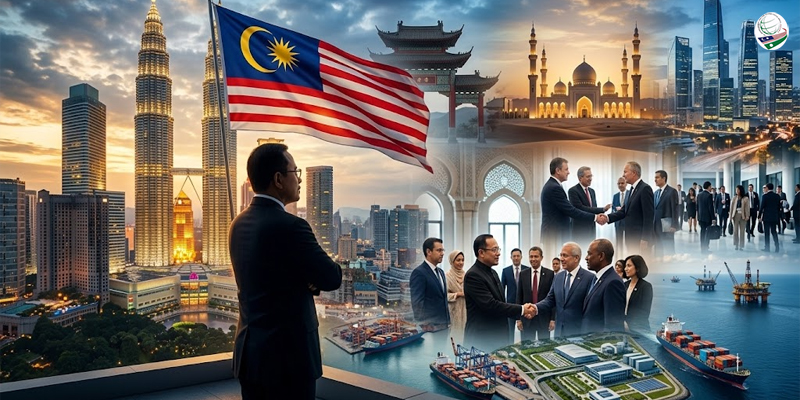
Recently, a narrative has emerged claiming that Prime Minister Datuk Seri Anwar Ibrahim’s greatest strength lies in his international influence.
This view was reinforced by Jason Yew’s article, which cited analyst Effendy Zulkifly’s argument that Malaysia today needs a global statesman more than merely a local politician.
However, the question is this: Is international diplomacy alone enough to determine the success of a leader?
Or are we becoming too fascinated with foreign relations that we are forgetting the primary responsibility of a national leader to defend the country’s own interests?
The reality is that Malaysia indeed needs good relations with all major world powers.
But friendship does not mean submission.
Attracting investments does not mean surrendering strategic national assets.
Diplomacy should never become an excuse for excessive dependence on foreign powers to the point where the nation loses its bargaining strength.
Malaysia Needs Investment, Not the Surrender of National Interests
Malaysia is an open trading nation.
The country’s economy depends heavily on international trade and foreign investment.
World Bank data shows that Malaysia’s trade exceeds 130% of its GDP, while exports account for approximately 68% to 71% of the nation’s GDP.
This proves that international relations are indeed important.
However, history has shown that many small nations eventually became weak because they depended too heavily on foreign powers.
Foreign investments should create jobs, transfer technology, improve local expertise, and strengthen domestic industries.
They should not turn the country into merely a consumer market or a place where foreign corporations extract profits.
That is why many believe Malaysia’s friendship with all sides approach must have clear boundaries so that national interests are not compromised.
Tun Mahathir Was Respected Globally Because of His Firmness, Not Because He Flattered Major Powers
The narrative that only Anwar Ibrahim possesses international influence is also inaccurate.
Tun Dr. Mahathir Mohamad has been internationally recognised for decades.
He was respected not because he was overly accommodating toward major powers, but because of his courage in defending the Muslim world and developing nations.
Among his well-known firm positions were criticising the Iraq War, defending Bosnia and Palestine, opposing Western economic dominance, criticising George Soros during the 1997 Asian Financial Crisis, and proposing the use of the Gold Dinar to reduce dependence on the US dollar.
Yet during the same period, Malaysia continued to receive foreign investments and experienced rapid economic growth.
This proves that a leader can earn global respect without appearing overly submissive to major powers.
Malaysia-China Relations Did Not Begin in the Current Era
There have also been attempts to create the impression that close Malaysia-China relations only flourished in recent years.
In reality, Malaysia-China economic relations had already grown significantly since Tun Mahathir’s era and expanded rapidly during Datuk Seri Najib Razak’s administration.
China has been Malaysia’s largest trading partner since 2009.
During Najib’s administration, numerous mega projects involving China were introduced, including the East Coast Rail Link (ECRL), Bandar Malaysia, Forest City, and various other major infrastructure investments.
International reports have even described the Najib era as the peak period of Chinese investment expansion in Malaysia.
Data also shows that bilateral trade between Malaysia and China increased tremendously, while China became one of the country’s largest sources of foreign direct investment (FDI).
This demonstrates that international relations are not exclusive to any single individual.
But Foreign Investments Also Carry Risks
Economic relations with major powers should not be viewed too romantically.
Academic studies on Chinese investments in Malaysia show both positive and negative impacts.
These include technology transfer, economic development, environmental concerns, and worries regarding strategic dependency.
Even the Najib era demonstrated how international relations and mega projects could create major risks when governance is weak.
The 1MDB scandal became an example of how global financial relationships without integrity could eventually damage the country itself.
Therefore, international diplomacy must always be built upon transparency, integrity, and national interest.
International Influence Does Not Depend on One Individual Alone
Another weakness in this narrative is the assumption that only one particular leader possesses international standing.
In reality, the diplomatic world constantly observes all political figures who have the potential to lead the country in the future.
For example, after Datuk Seri Dr. Ahmad Samsuri Mokhtar was appointed Chairman of Perikatan Nasional, many diplomats and international observers began paying attention to him.
This is not unusual.
In international diplomacy, foreign embassies build relationships with both governments and opposition leaders; they study emerging political figures, and they seek to understand possible future political shifts.
Dr. Samsuri: A Technocrat, Professional, and Clean-Cut Leader
Dr. Samsuri possesses a far more technocratic background than many politicians.
He has an aerospace engineering background, was involved in the oil and gas industry, carries a professional image, and is regarded as one of PAS’s more moderate and widely acceptable leaders.
As Menteri Besar of Terengganu since 2018 he has maintained political stability in the state, led Perikatan Nasional to win all 32 state assembly seats and all 8 parliamentary seats in Terengganu during the 2023 state election, and was later unanimously chosen as Chairman of Perikatan Nasional.
That overwhelming victory itself sends a message that he is not merely a local political champion.
In international politics, administrative stability and governance capability are also important factors in building diplomatic confidence.
National Strength Cannot Depend on the Aura of One Individual
What is more worrying is when national politics becomes too dependent on the personality of a single leader.
A mature nation is not built upon the aura of individuals, but upon strong institutions, economic stability, administrative integrity, a trusted judicial system, and consistent national policies.
International relations are important, but national dignity matters more.
Malaysia needs leaders who can maintain good relations with all major powers, but still dare to defend national interests, are not overly dependent on any bloc, and ensure that local citizens receive genuine benefits from foreign investments.
In today’s increasingly uncertain world, good leaders are not merely those who are warmly welcomed abroad.
They are those who ensure that their own country continues to be respected.