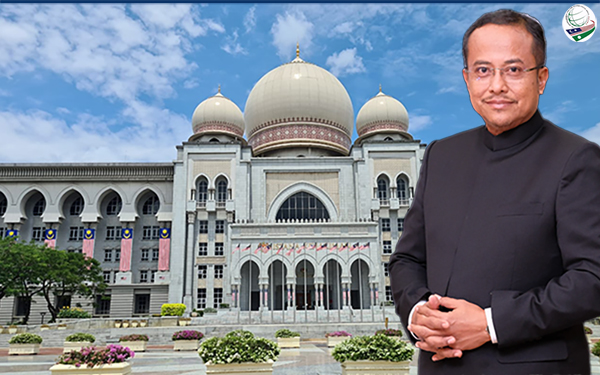
The appointment of Dato’ Seri Ir. Dr. Ahmad Samsuri Mokhtar (better known as Dr Sam) as Chairman of Perikatan Nasional (PN) symbolizes a generational shift, a transformation in political style, and the emergence of a more technocratic, performance-oriented approach to governance.
The heated reactions on social media are not unusual. In Malaysian politics, anxiety often intensifies when a figure emerges who is difficult to attack and capable of changing the old rules of the game.
One recurring criticism is that Dr Sam “lacks the wow factor.”
This critique reflects an outdated political appetite overly dependent on rhetoric, drama, and polemics—as though leadership must be measured by one’s ability to put on a show.
In reality, Dr Sam is not an aggressive debater like Prime Minister Anwar Ibrahim, who is renowned for his ability to outmaneuver opponents in Parliament. Nor is he a flamboyant figure who treats politics as a stage performance.
However, national leadership is not a debating contest.
Malaysia is facing economic challenges, rising living costs, technological transformation, and global competition that require leaders who think strategically, speak when necessary, remain silent when appropriate, and work consistently.
At a time when the public is increasingly fatigued by conflict, a calm and professional demeanor is an added value—not a weakness.
The Question of Experience
A second criticism claims that Dr Sam “lacks experience.”
This accusation is inaccurate if experience is assessed comprehensively.
Dr Sam is an aerospace engineer holding the professional title “Ir.” He possesses a strong academic background as a lecturer and professor and has served as Menteri Besar of Terengganu since 2018.
His leadership experience is not cosmetic. It is grounded in managing a state with more limited resources than some others, navigating revenue constraints, and balancing development demands with social stability.
Stable governance, the absence of major scandals that could destabilize the state government, and the ability to maintain order in Terengganu demonstrate substantive administrative experience—experience rooted in governance itself.
Comparisons with Other Leaders
A third criticism argues that Dr Sam is “not on par” with leaders such as Anwar or Muhyiddin Yassin, who have served as Prime Minister or held senior federal positions.
Such comparisons narrow the definition of qualification to having been Prime Minister or minister. In reality, a nation requires diversity in leadership profiles.
Anwar is widely recognized as a veteran political figure known for oratory and negotiation. Muhyiddin is known as an administrator deeply embedded in federal government structures.
Dr Sam presents a different profile: a moderate Islamist technocrat with a strong academic foundation, focused on work, and relatively unburdened by major political baggage or personal controversies that could easily be weaponized against him.
In a political climate that increasingly demands moderation and professionalism, this difference in style is not a liability but a strategic asset.
Professional Discipline and Leadership Style
From an academic perspective, Dr Sam—like Mahathir Mohamad before him—possesses a professional training background that emphasizes structured analysis, precision, systematic problem-solving, and decision-making based on diagnosis and data.
Mahathir, as a medical doctor, and Samsuri, as an aerospace engineer, were trained in disciplines that cultivate technocratic, results-oriented leadership styles and risk management awareness.
In contrast, a literary background may excel in discourse and political communication. Professional training in medicine and engineering, however, tends to foster technical and systems-based thinking—particularly valuable when facing complex economic, technological, and governance challenges.
Should He Focus Only on the State?
Another criticism suggests that Dr Sam should focus solely on governing Terengganu.
This logic is weak. In Malaysia’s political tradition, many Chief Ministers and Menteri Besar have simultaneously held national party positions without neglecting their states.
The strong mandate given by Terengganu voters demonstrates that state administration does not collapse merely because its leader assumes broader responsibilities.
On the contrary, effective state governance often serves as a foundation for national leadership.
Allegations of “Failure” in Terengganu
Claims that Dr Sam “failed to manage Terengganu” lack clear evidence and appear rooted in political perception or opposition sentiment.
Terengganu is often cited as among the happiest states in Malaysia. The state administration has remained stable, free from major internal crises.
Observers note improvements in financial management, resolution of abandoned projects, and preservation of social harmony and moral development.
If the administration had truly failed, it would be difficult to explain the sustained political stability and public confidence in the state government.
Recognition Beyond Party Lines
Significantly, appreciation for Dr Sam does not come solely from supporters of Parti Islam Se-Malaysia (PAS).
Lt. Col. (Assoc.) Nik Saiful Adli Borhan of United Malays National Organisation (UMNO) Ketereh, for example, described the appointment of a PN chairman who is not a party president as a sign of willingness to break tradition and embrace reform. He highlighted Dr Sam as a 55-year-old professional leader without a criminal record or a history of inflammatory speech.
Journalist Fathi Aris Omar, often critical of PAS, previously argued that PAS had long “rowed the ship but handed the captaincy to others.” He viewed Dr Sam as the most suitable candidate for PAS to confidently project its own leadership.
When praise comes from across the political spectrum, the message is clear: this appointment is not merely an internal victory but recognition of a leadership profile that cannot be easily dismissed.
Addressing the Trust Deficit
More importantly, Dr Sam’s appointment opens space for PN to rebuild public confidence through institutional strengthening and a culture of integrity.
Malaysia is currently facing a trust deficit in parts of its institutions due to perceptions of transparency issues, political interference, leakages, and governance weaknesses.
In such an environment, a leader with a clean image, minimal controversy, moderation, and professionalism can symbolize efforts to restore credibility.
Public trust cannot be rebuilt through slogans alone. It must begin with leadership that upholds discipline, governance standards, and transparency.
A Shift in National Leadership Patterns
Another important dimension is that since independence, all Prime Ministers have come either from UMNO or were former UMNO leaders.
This indicates that national leadership has largely revolved within the same political elite circle.
In this context, Dr Sam’s appointment as PN Chairman opens discussion about whether Malaysia is ready to consider leadership emerging from other parties—particularly PAS.
This is not a matter of party sentiment, but of democratic maturity and readiness to accept shifts in power patterns.
PAS is currently the largest party in Parliament in terms of seats. In a democratic system, electoral strength logically translates into leadership opportunity.
Allowing figures like Dr Sam to rise also carries the potential for a performance-based, integrity-driven, and disciplined administrative approach aligned with voters who increasingly evaluate leaders based on results rather than rhetoric.
Conclusion
The discomfort expressed by certain quarters is not merely about who Dr Sam is, but what he represents.
He is not a product of old-style politics sustained by drama. He is not easily undermined by personal attacks due to the absence of significant controversy.
He embodies a narrative that leadership does not need to be loud to be effective, nor flamboyant to inspire confidence.
Whether he advances further or not will be determined by time. What is already evident, however, is that this shift in leadership style has unsettled the comfort zone of old political patterns and may mark the beginning of a more mature phase in Malaysian politics.
By: Dr Nur Ayuni Mohd Isa
Political Analyst
Senior Lecturer, Universiti Putra Malaysia (UPM)
Postdoctoral Researcher, Department of Politics and International Studies, Centre for Southeast Asian Studies (SEAC), SOAS University of London